
CrawlRadar

Know if AI can find, read and recommend your website

See which AI bots crawl your site, how many visitors AI sends you, and what to fix.

14-day free trial. No credit card.
Tracks GPTBot, ClaudeBot, PerplexityBot, GoogleOther, Copilot, Meta-ExternalAgent, Amazonbot, Bytespider, xAI-SearchBot, DeepSeekBot and more.
Our own dashboard, live. Open it full screen →
ChatGPTClaudePerplexityGeminiCopilotGrokChatGPTClaudePerplexityGeminiCopilotGrok
GPTBotClaudeBotPerplexityBotGoogleOtherCopilotMeta-ExternalAgentAmazonbotBytespiderxAI-SearchBotDeepSeekBotOAI-SearchBotChatGPT-UserClaude-UserPerplexity-UserDuckAssistBot

What Google Analytics can’t show you

AI crawlers don’t run JavaScript, so your analytics never sees them.

  • Which AI bots crawl you

    GPTBot, ClaudeBot, PerplexityBot and the rest, by page and by day. Verified against each vendor’s IP ranges, so spoofed bots don’t count.

  • What stops them

    A 0–100 score for every page from 14 checks, with blockers flagged first and fixes ranked by impact.

  • How many visitors AI sends

    Visits from ChatGPT, Perplexity, Gemini, Claude and Copilot, and the pages they land on. Most analytics file them as direct.

Live in 2 minutes

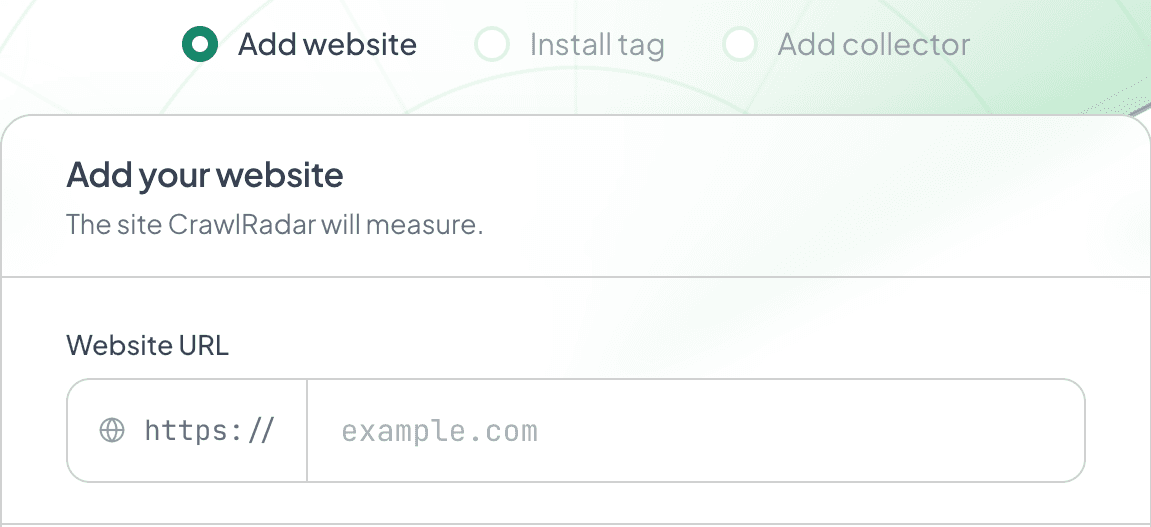
  1. The Add a website screen, with a field for the website URL

    Add your website

    Enter your domain. Sign in with Google or email.

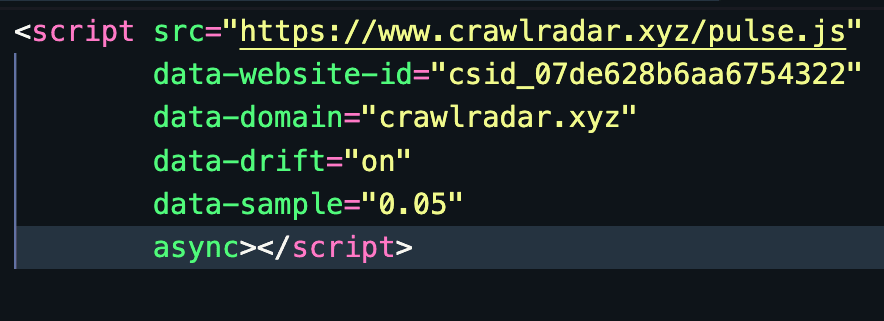
  2. The CrawlRadar tracking script tag, ready to paste into a website

    Paste two snippets

    A tag for AI traffic, a collector for crawlers. Or install the WordPress plugin.

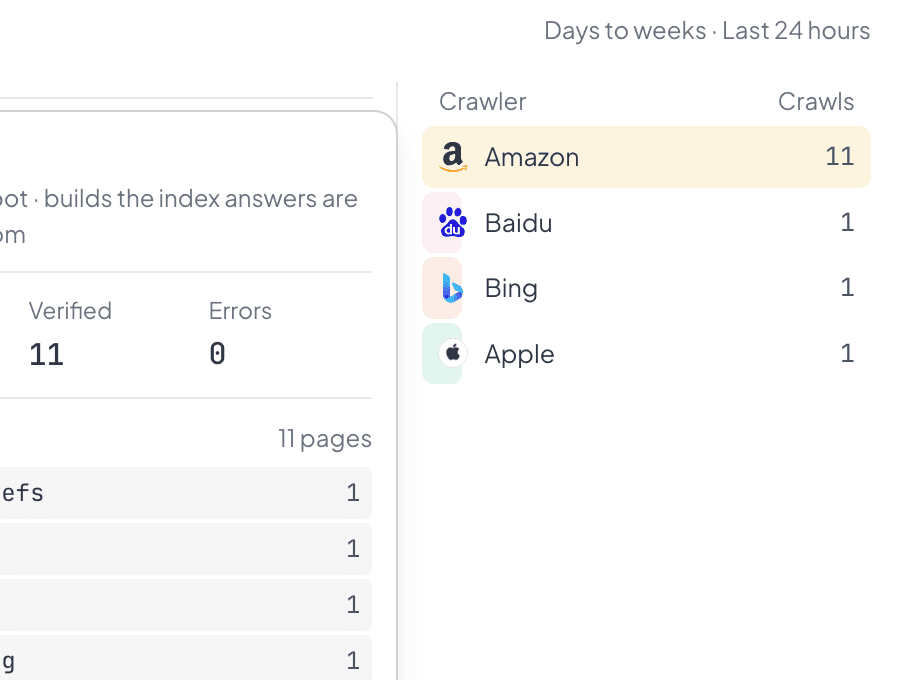
  3. The crawler panel, showing Amazonbot’s verified crawls and the pages it fetched

    Watch and fix

    AI crawls and visits show up live. Fix what is flagged.

14-day free trial. No credit card.

Why AI skips pages that rank fine on Google

Google links to your page. AI has to quote it. Three problems cause most misses.

  • 13 points at stake

    The answer is buried

    AI quotes the first passage that answers the question. An intro that restates it gives the engine nothing to lift.

    “In this guide we’ll explore…”
  • 10 points at stake

    The paragraph does not stand alone

    Answers are built from chunks, not pages. A paragraph that opens with a bare pronoun makes no sense on its own, so it never gets quoted.

    “This means the opposite is also true.”
  • 8 points at stake

    The page is invisible

    A robots.txt rule, a stray noindex, or content that only renders in JavaScript. Fixable in minutes, fatal until then.

    User-agent: GPTBot → Disallow: /

A score you can check

14 checks, every weight published: 25 points for access, 15 for trust, 60 for a passage worth quoting.

See every check
Points at stakeof 100

answer-first alone is worth 13 points.

  • answer-first: 13 points
  • extractability: 10 points
  • headings: 9 points
  • scannability: 9 points
  • crawler-access: 8 points
  • specifics: 8 points
  • render-dependency: 7 points

Hand the fixes to your coding agent

One click copies a fix prompt for Claude Code, Cursor or Codex. Paste it, and the agent fixes what blocks AI.

An illustrative transcript of a coding agent applying a CrawlRadar fix prompt. The point values are the engine’s real check weights.
Here’s the CrawlRadar fix prompt for /blog/guide. Apply it.
Reading the evidence payload: 3 blockers, 5 ranked fixes.
rewrite_section_openers+13 pts
add_faqpage_jsonld+7 pts
unblock_gptbotblocker
Worked for 41s
  • edited content/blog/guide.mdx 4 sections
  • edited app/blog/[slug]/page.tsx +1 schema block
  • edited public/robots.txt -1 group
Re-scan: 61 → 88 (grade B → A). 2 checks left, both marked low effort.
Illustrative transcript, real check weights.

Every major AI crawler, by name

Logged when they visit, checked against your robots.txt.

  • CrawlRadar checks GPTBot

    OpenAI (training + search index)

  • CrawlRadar checks OAI-SearchBot

    ChatGPT Search

  • CrawlRadar checks ClaudeBot

    Anthropic / Claude

  • CrawlRadar checks PerplexityBot

    Perplexity index

  • CrawlRadar checks Google-Extended

    Google AI Overviews / Gemini

  • CrawlRadar checks ChatGPT-User
  • CrawlRadar checks anthropic-ai
  • CrawlRadar checks Perplexity-User
  • CrawlRadar checks CCBot
  • CrawlRadar checks Bytespider
  • CrawlRadar checks Amazonbot
  • CrawlRadar checks Applebot-Extended
14-day free trial. No credit card.

Hey, here is why this exists

SEO and analytics tools measure a search box people use less every month. None of them tell you whether GPTBot can reach your pages, or whether ChatGPT sent you anyone last week.

CrawlRadar measures what can be observed: the crawls, the AI visits, and whether a page can be read. Then it hands you the fix, not just the finding.

No tool can promise you citations. CrawlRadar shows you what it can prove, and says so when a signal is unproven.

Report
crawlradar.xyz
Ready to be cited
91Grade A

Ready to be cited

This page scores 91 on our own engine. Every public page on this site must clear 85, or the build fails.

Simple pricing. Free for 14 days.

From $9 a month. Every feature on both plans, and AI crawls never count toward your bill.

10k10M
Only human pageviews count. AI crawler visits are free and unlimited.
3 months free
Starter
One website, every feature
$9/month
Or $6.75/month billed yearly
More than one site? Growth includes 10.
  • 1 website
  • 10k pageviews a month
  • Unlimited AI crawler visits, never counted
  • AI traffic from ChatGPT, Perplexity, Gemini, Claude
  • Readiness score and fix prompts for every page
  • Monitoring and email alerts on 10 pages
  • Sitemap audits, up to 100 URLs per run
Start 14-day free trial
$0.00 due today. No card required.
GrowthBest value
Every feature, for all your sites
$19/month
Or $14.25/month billed yearly
10 websites included
10
  • 10 websites, +$2/mo per extra site
  • 10k pageviews a month, shared across sites
  • Unlimited AI crawler visits, never counted
  • Everything in Starter
  • Monitoring and email alerts on 100 pages
  • Sitemap audits, up to 500 URLs per run
  • Priority support from the founder
Start 14-day free trial
$0.00 due today. No card required.
  • 14 days free, no card
    Every feature, on your own site, before you pay a cent.
  • AI crawls never count
    Only human pageviews are metered. A bot spike can’t move your bill.
  • No surprise bills
    Go over your pageviews and we keep tracking and email you. Never an automatic charge.
  • 30-day money-back
    Not worth it? Email us within 30 days of your first payment for a full refund.

Compare plans

Both plans include every feature. Growth adds websites, monitored pages and audit size.

FeatureStarterGrowth
Usage
Websites110, then $2/mo each
Monthly pageviews10k to 10MSame, shared across sites
AI crawler visitsUnlimitedUnlimited
AI crawlers
AI crawlers identified by name56+56+
Verified against vendor IP rangesIncludedIncluded
Pages each crawler fetches, by dayIncludedIncluded
AI traffic
Visits from ChatGPT, Perplexity, Gemini, Claude, CopilotIncludedIncluded
Landing pages for AI visitsIncludedIncluded
Fix
Readiness score, 14 checks per pageIncludedIncluded
Fix prompts for Claude Code, Cursor, CodexIncludedIncluded
Sitemap audit100 URLs per run500 URLs per run
AI checks on your own API keyIncludedIncluded
Monitor
Monitored pages with email alerts10100
Score history and trend linesIncludedIncluded
PDF, PNG and CSV exportIncludedIncluded
Support
SupportEmailPriority, from the founder

FAQ

Frequently asked questions

What it does first, then the questions that decide whether to pay for it.

  • What does CrawlRadar do?

    CrawlRadar tells you whether AI can find, read and recommend your website. It shows which AI crawlers visit your site and which pages they fetch, counts the visitors ChatGPT, Perplexity, Gemini, Claude and Copilot send you, and scores each page 0–100 on whether an answer engine can use it, with the fixes ranked by impact.
  • How do I know if ChatGPT is sending me traffic?

    Add your website and install the tracking tag, one script tag in your site header. It recognises visits that arrive from AI assistants, which most analytics tools file under direct or unknown, and shows them by assistant and by landing page. The AI crawler collector is a separate snippet that shows the crawls that come before those visits.
  • How much does CrawlRadar cost?

    Starter is $9 a month for one website and 10k pageviews; Growth is $19 a month for 10 websites. Both scale with your monthly pageviews, extra websites on Growth are $2 a month each, and yearly billing gives you 3 months free. AI crawler visits never count toward your plan. See the calculator.
  • Is there a free plan?

    No, there is a 14-day free trial of everything, with no card. The free tools stay free with no account: the GEO score checker, the AI crawler checker, the llms.txt and schema generators, and the Chrome extension.
  • Do I need a credit card for the trial?

    No. You add your website and sign in with Google or email, and the 14 days start there. Nothing is charged when the trial ends, because there is no card on file: you pick Starter or Growth with your own numbers in front of you.
  • What counts as a pageview?

    A page a person loads on a website where the tracking tag is installed. AI crawler visits reported by the collector are never counted, on any plan, so a spike from GPTBot or ClaudeBot cannot change your bill.
  • What if I go over my pageviews?

    We keep tracking and email you to suggest the next tier. Nothing is charged automatically, and nothing stops recording because your site had a good month.
  • How is GEO different from SEO?

    SEO optimises for a ranked list of links; GEO optimises for being quoted inside a generated answer. The overlap is real but partial: a page can rank first on Google and still be unusable to ChatGPT because its answer is buried under three paragraphs of setup, or because robots.txt blocks GPTBot. The long version is in the guide.
  • Does blocking GPTBot in robots.txt stop ChatGPT citing me?

    Yes, for the indexed path. GPTBot builds the index ChatGPT searches, so a site that disallows it will not appear as a source in ChatGPT answers regardless of how good the content is. CrawlRadar flags this as a blocking issue rather than a scoring deduction, because no amount of content work compensates for it. Check your own robots.txt.
  • What exactly does the score measure?

    14 checks across three levers: whether a crawler can retrieve the page at all (25 points), whether the source reads as trustworthy and current (15 points), and whether there is a passage worth lifting and quoting (60 points). Every weight is published. The heaviest single check is answer-first structure at 13 points. Nothing is held back for the paid plans; the free scan runs the identical engine. See the full model.
  • Does CrawlRadar run JavaScript when it scans a page?

    No, and neither do the crawlers. The server fetches your HTML once, as an unauthenticated crawler, and never executes the page’s JavaScript. That is deliberate: most AI crawlers do not execute JavaScript either, so what CrawlRadar parses is what they actually see. The render-dependency check exists to tell you how much of your page only appears after JavaScript runs.
  • Can I scan staging sites or pages behind a login?

    Yes, with the Chrome extension. It scores the page in front of you, in your browser, using the session you are already signed in with, so staging sites, drafts in your CMS and pages behind a login all work. The web scanner cannot reach those, because it fetches from our server as an anonymous crawler would.
  • What does the Chrome extension send to your servers?

    Nothing about the pages you scan. The scoring engine runs on your machine, results are held only while the popup is open, and no page content, URL or score is transmitted, whatever your plan. The extension requests activeTab and scripting at install and no host permissions, which is why Chrome shows no site-access warning. The privacy page lists every case where something can leave your device.
  • Do the AI checks cost extra?

    No, and they run on your own API key. You paste an OpenAI, Anthropic or Perplexity key into the extension, it is stored locally in your browser, and the calls go straight from your browser to that provider. CrawlRadar never receives the key and never sees the bill, which is also why those checks are included rather than metered.
  • How do I see which AI crawlers actually hit my site?

    You install the collector. GPTBot does not run JavaScript, so no analytics tag sees it. The only way to observe an AI crawl is from your own request path. CrawlRadar generates three snippets for that: a Cloudflare Worker, a Next.js middleware and a Node/Express handler. Each hit is then checked against the vendor’s published IP ranges and reported as verified, spoofed, or unchecked when nobody could tell.
  • Can I audit a whole sitemap?

    Yes. Point CrawlRadar at a sitemap and it scores every URL in one run, up to 100 on Starter and 500 on Growth, then ranks the whole site by points recoverable so you know which pages to fix first.
  • What happens if I cancel?

    You keep your plan until the end of the period you already paid for, and there is no exit fee. Your data is kept for 30 days after you leave, and if you cancel within 30 days of your first payment you get a full refund.
  • What do you store, and is CrawlRadar GDPR compliant?

    For an account we hold an email address, a plan status, the scans you saved, and for each website you add, the pageviews its tag reports and the crawls its collector reports. The tag has a cookieless mode. A scan you do not save is never written down, and the extension keeps results only while its popup is open. We do not sell data, share it with advertisers, or run advertising, fingerprinting or cross-site tracking. The privacy page is written from the code, not from intent.

Scan any page from Chrome

Score the page you’re on, even staging or behind a login. No site access requested, nothing sent to us.

Install the free extension

All 14 checks, and what each is worth

The same engine runs on Free, on Pro and in the extension.

CheckLeverPoints
answer-firstSelected13
extractabilitySelected10
headingsSelected9
scannabilitySelected9
crawler-accessRetrieved8
specificsSelected8
render-dependencyRetrieved7
entity-clarityRanked7
faqSelected7
indexabilityRetrieved6
llms-txtRetrieved4
freshnessRanked4
topical-focusRanked4
schemaSelected4
Total25 / 15 / 60100

Grades run A ≥ 85, B 70–84, C 55–69, D 40–54, F under 40. A check that cannot be measured, such as a robots.txt that times out, is reported as not checked and removed from the denominator, never scored as a zero. A score you cannot trust is worse than no score.

The heaviest single check is answer-first structure at 13 points, followed by chunk extractability at 10 and heading hierarchy at 9. Retrieval checks are cheaper individually: crawler access is 8 points and indexability 6, because they are usually one-line fixes in robots.txt or a meta tag, while an answer buried under two paragraphs of preamble is a rewrite.

Retrieved

25 pts

Retrieval decides whether GPTBot, ClaudeBot, PerplexityBot and Google-Extended can fetch this URL and read it at all, without running any JavaScript.

  • Crawler access

    8 pt

    crawler-access

    Reads robots.txt group by group, the way each agent does, and reports which AI crawlers are allowed on the exact path you scanned.

  • Render dependency

    7 pt

    render-dependency

    Compares raw HTML against rendered text. Content that only appears after JavaScript runs is content most AI crawlers never receive.

  • Indexability

    6 pt

    indexability

    The noindex tag, the canonical target and the status code: three ways a page quietly removes itself from an index.

  • llms.txt

    4 pt

    llms-txt

    Checks for a published llms.txt. It is an emerging convention with no proven citation impact yet, which is why it is worth four points and not twenty.

Ranked

15 pts

Ranking measures whether the page names an author, carries a machine-readable date, and holds to one subject tightly enough to be trusted as a source.

  • Entity clarity

    7 pt

    entity-clarity

    Named author, publisher and organisation markup, so a model can establish who is speaking and why they would know.

  • Freshness

    4 pt

    freshness

    Published and modified dates, and whether they are machine-readable rather than only printed for humans.

  • Topical focus

    4 pt

    topical-focus

    How tightly the page holds one subject. A page about everything is retrieved for nothing.

Selected

60 pts

Selection is where almost every page that already ranks on Google loses the citation, because a passage has to survive being lifted out on its own.

  • Answer-first structure

    13 pt

    answer-first

    Whether each section answers its own heading in the first sentence. This is the heaviest check on the model because it is the one that decides whether there is anything to lift.

  • Chunk extractability

    10 pt

    extractability

    Whether a paragraph still means something once it is lifted out of the page, which is the only state an answer engine ever reads it in.

  • Heading hierarchy

    9 pt

    headings

    Whether the outline is well-formed and whether headings read as the questions their sections answer.

  • Scannability

    9 pt

    scannability

    Paragraph length, sentence length, lists and tables: the structure that survives being split into chunks.

  • Specifics

    8 pt

    specifics

    Numbers, dates, names and units. Concrete claims get quoted; generalities get paraphrased into someone else’s answer.

  • Question and answer pairs

    7 pt

    faq

    Detects genuine Q&A structure, the format answer engines lift most readily because the question is already matched for them.

  • Schema

    4 pt

    schema

    Validates JSON-LD for the four types that carry citation weight: Article, FAQPage, HowTo and Organization.

Can AI find your website?

14-day free trial. No credit card.